Showing posts with label churches. Show all posts

Thursday, 7 September 2017

Miracle of Rotunda of Mosta Malta..June/July 2017

It was 26 years since I visited Malta , I had to return to the land of my
fathers. It just felt amazing to be there. 


I had wanted to go back to this church , so I just hopped on a bus.
So easy and cheap to get around Malta and I was amazed at how
well I did. So were my cousins. I spent most of the days
going around on my own. But it was fine , they were
at the end of a phone and we had lots of time together.

The Parish Church of the Assumption is more often than not ,  known as the Rotunda of Mosta  or the Mosta Dome. It is a Roman Catholic Parish church,  built between 1833 and the 1860s to neoclassical designs of Giorgio Grognet de Vassé, on the site of an earlier Renaissance church which had been built in around 1614 to designs of Tommaso Dingli.


(read more info in link above)


The design of the present church is based on the Pantheon in Rome, and it is said to have the third largest unsupported dome in the world.


THE MIRACLE
 
The church narrowly avoided destruction during World War II.  
 
On the 9th April 1942
A German aerial
bomb pierced the dome and fell into the
church during Mass but failed to explode.
 
 
This event was interpreted by the Maltese as a miracle.
 
 
I always light a candle ..
mine is the one to the left of the photo.


Beautiful Dome , work of Art..


Stunning designs. 


The photo below is of a small dome and I was determined to get
this one right , but it was hard.. as you can imagine. I was
leaning over backwards. Looks like the sky. 


Slowly but surely I will do blogging.
And share more of my trip to
FABULOUS MALTA.
♥♥♥♥♥♥♥♥
 

Wednesday, 19 July 2017

Cheapside - An Area in London with Lots of History..

Jennifer and I just stayed in this area for day ..
 
Walking with the map and then maybe taking a detour ,
here and there..!!
 
You definitely need to look up and down here.
 
 
Started out at Monument and walked the dotted line
with detours ..


Cheapside takes its name from ‘chepe’, a Saxon word for a market.
The street connected the southern end of the Roman Watling Street with the main City settlement to its east and its alignment was dictated by a convenient bridging point across the (now subterranean) River Walbrook. 


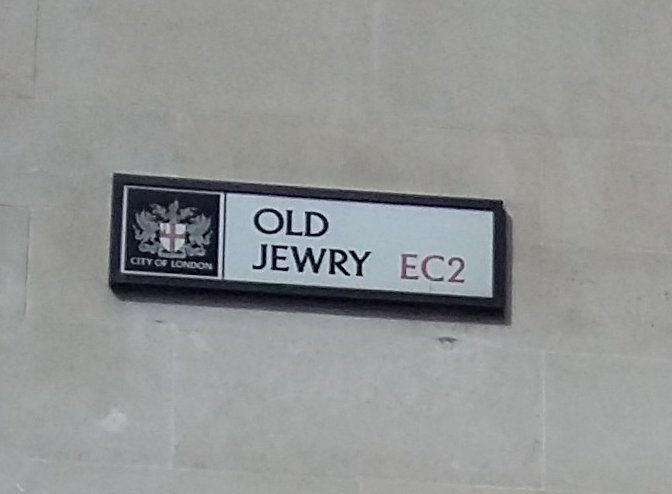
Old Jewry is a one-way street in the City of London, the historic and financial centre of London. It is located within Coleman Street ward and links Poultry to Gresham Street.
 
William the Conqueror encouraged Jews to come to England soon after the Norman Conquest; some settled in cities throughout his new domain, including in London. According to Reverend Moses Margoliouth, Old Jewry was a ghetto. Ghettos, areas of a city mainly or exclusively populated by Jews, were common across Europe. In 2001, archaeologists discovered a mikveh (ritual bath) near to Old Jewry, on the corner of Gresham Street and Milk Street, under what is now the State Bank of India. It would have fallen into disuse after 1290, when the Jews were expelled from England.


The earliest Ashkenazi synagogue constructed in London after the return of Jews to England in the 17th century was built about 1690 at Duke's Place, north of Aldgate. In 1696-7, the synagogue also acquired a burial ground, at Alderney Road.


Love the OLD and NEW


 on
The Bank of England,
Prince's Street / Lothbury, EC2

The statue is by Charles Wheeler, who produced several works for the rebuilt Bank, of which Ariel is the most highly regarded and gained the Royal British Society of Sculptors’ medal for the best work of the year in 1937
 
 
This is taken from Tivoli Corner
 
In 1805 Sir John Soane, the architect responsible for the rebuilding of the Bank of England, completed his own, typically idiosyncratic, contribution to the craze: his Tivoli Corner, a spherical enclosure tagged on to the Bank at the junction of Lothbury and Prince's Street. It is a tomb-like, functionless space enclosed with weighty neoclassical columns and it can be entered from the north or west. Its roof is a portal, open to the sky, around which is carved a dedication to the citizens of London.


(It took me ages to find where I took the photo from, wasn't going to give up!!)
 
I love this photo.


The map below shows Founders Court..


 Below is just a little piece of the history of the Hall..
more in the link above.

(taken from the internet)

The Founders' Company began its existence as one of the early medieval "guilds" or associations formed by members of various crafts or trades in the City of London. Their main purposes were to defend the craft against unfair competition, to assist its members in their work, to help those in distress and to promote and control education.

Founders were workers in brass and brass alloys or tinplate known as "Iatten" or "laton", producing small cast articles such as candlesticks and pots and pans. Their workshops were situated in and around Lothbury, a street that still exists under that name.

From 1508 to 1987 their parish church was St. Margaret Lothbury. Before that time, the Founders were associated with the church of St. Lawrence Jewry, and indeed there is evidence to suggest that the medieval guild grew out of a parish fraternity known as the Brotherhood of St. Clement, based on the church of St. Lawrence Jewry, which served the spiritual and material needs of its members.


Cheap is a small ward in the City of London.
It stretches west to east from King Edward Street, the border with Farringdon
Within ward, to Old Jewry, which adjoins Walbrook; and north to south from Gresham Street, the border with Aldersgate and Bassishaw wards, to Cheapside, the boundary with Cordwainer and Bread Street wards.
 
The name Cheap derives from the Old English word "chep" for "market"


St Lawrence Jewry next Guildhall is a Church of England guild church in the City of London on Gresham Street, next to Guildhall. It was destroyed in the Great Fire of London in 1666, and rebuilt to the designs of Sir Christopher Wren
 
St Lawrence Jewry is the official church of the Lord Mayor of London and the City of London Corporation and stands in the Yard of the Guildhall.


This is the St George Window in the Commonwealth Chapel
 

The church is regularly open weekdays and for special events such as an annual music festival in August offering daily lunchtime concerts. It is well worth visiting, especially since you can easily combine a visit to St Lawrence with a visit to the Guildhall,
its excellent art gallery, and the Roman amphitheatre discovered under Guildhall Yard during building of the Gallery


I do hope you have enjoyed this small tour.. I do have a little
bit more to write about. Jennifer and I did this little  tour in a DAY!!
 
All information is from the web - and links included.
 
♥♥♥♥♥♥♥♥


Tuesday, 18 July 2017

London and more History ...

Onward we go (Jennifer and I) ...we followed the map...
and found
 
St Mary-le-Bow which
 is an historic church rebuilt after the Great Fire of 1666 by Sir Christopher Wren in the City of London[ on the main east–west thoroughfare, Cheapside.


Founded in or around 1080 as the London headquarters of the archbishops of Canterbury, the medieval church of St Mary-le-Bow survived three devastating collapses before being completely destroyed in the Great Fire of 1666. Rebuilt by Sir Christopher Wren, it was destroyed once more in 1941 but was again rebuilt and re-consecrated in 1964.
If you would like to read more of the history , here is a link..


All Hallows , Bread Street
(mentioned in the plaque below)
 
 was a parish church in the Bread Street ward of the City of London. It stood on the east side of Bread Street, on the corner with Watling Street First mentioned in the 13th century, the church was destroyed in the Great Fire of London in 1666 and was rebuilt by the office of Sir Christopher Wren and demolished in 1878.
 
 
The parish of All Hallows Bread Street was combined with that of St Mary-le-Bow (the church mentioned at the beginning) in 1876 and the church demolished in 1878, under the Union of Benefices Act 1860. The site and materials were sold for £32,254 and the proceeds used to build All Hallows East India Dock Road. The furnishings were dispersed to several churches – the pulpit is now in St Vedast alias Foster, the organ case in St Mary Abchurch and the font cover in St Andrew-by-the-Wardrobe.


Below is  a café restaurant , I didn't get the same feel
as the previous church.  We didn't stop as
we had just coffeed and eaten.

I am sure it would just as tasty. 

 
LOTS MORE TO COME ..
♥♥♥♥♥♥♥♥♥

Tuesday, 6 June 2017

Our day out in London started at .....


The Monument to the Great Fire of London, more commonly known simply as the Monument, is a Doric column in the City of London, near the northern end of London Bridge, that commemorates the Great Fire of London.
It stands at the junction of Monument Street and Fish Street Hill, 202 ft (62 m) tall and 202 ft (62 m) from the spot in Pudding Lane where the Great Fire started on 2 September 1666.


Whilst googling, I came across a blog post all about this area ..
 The blog is called A London Inheritance Very interesting for
those that love London and it's history.


I love the architectural difference between
the old and the new.
 

Skanska developed and constructed The Monument Building,
in the heart of the city of London.
 It creates a stunning backdrop to The Monument,
the famous landmark that commemorates the Great Fire of London in 1666.
 
 
One of the striking features is the twisting fins on its south side,
which are made in Italy from anodised aluminium.
The 69 fins create a signature pattern and
are designed to let in as much natural light as possible,
while shading the building from heat gain.


Old and New


The church below is

St Mary Abchurch

Which  is  Church of England,  off Cannon Street in the City of London.
Dedicated to the Blessed Virgin Mary, it is first mentioned in 1198–1199.
The medieval church was destroyed in the Great Fire of London in 1666,
 and replaced by the present building.

We did try and get in but lots of building work going on.


Hope you enjoyed this little piece of London history.
Jennifer and I had a great time . Still more to come.
 
♥♥♥♥♥♥♥